
The Unlikely Pilgrimage of Harold Fry, Theatre Royal Haymarket, London, March 2026: Made in Britain
April 2026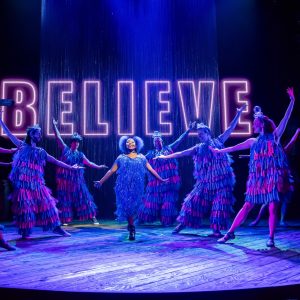
Photographs by Tristram Kenton
The Unlikely Pilgrimage of Harold Fry has made a rather unlikely pilgrimage to the West End from Chichester Festival Theatre, where it opened in May 2025. It is a very British musical — small in scale, well-intentioned, warm, and free of cynicism. Based on Rachel Joyce’s 2012 novel, with music and lyrics by Passenger, the production attempts to walk a fine line between embracing the intimacy of the story and succeeding as a piece of West End musical theatre.
It is precisely in that balancing act that the production begins to falter. The Unlikely Pilgrimage of Harold Fry is not a particularly exciting piece of theatre, though it tries hard. More than that, it exemplifies a recurring problem in several recent new British musicals: a question of taste in the choice of material, and too little intrinsic understanding of the art form. It is by no stretch of the imagination a bad musical; it is simply an easily forgettable one, apart from some of its component parts — chiefly the performances of its two leads.
There have, of course, been very good British musicals in recent years, but they remain rare exceptions. A personal favourite is Richard Thomas and Stewart Lee’s profane, riotously funny, and unexpectedly poignant Jerry Springer: The Opera, from 2003. One of its great surprises lay in the subject matter: Thomas and Lee took a distinctly American phenomenon and understood it in a way that now seems almost prophetic. They grasped the deeper significance of this peculiarly American story and transformed it into something universal that resonated with British audiences.
Jerry Springer: The Opera isn’t a perfect musical, but it is a deeply enjoyable and thought-provoking one. Its primary weakness lay in its second half, which could not quite sustain the brilliance of the first act — though how could it, when that act ended with a stage filled with hooded tap-dancing Ku Klux Klansmen?
Less assured and satisfying than what had come before, it nevertheless brought added depth and meaning to the piece and thus served a clear purpose.
Like the other great potty-mouthed musical success, The Book of Mormon, Jerry Springer: The Opera is about more than the sacrilegious potshots and gloriously inventive, seemingly endless array of swear words. It exposes a truth about who we are, and perhaps have long been, since at least the days when Rome’s Colosseum entertained the masses with men fighting bears, other men, and other wild animals.
The Unlikely Pilgrimage of Harold Fry is the story of an ordinary man in his sixties, who lives an unremarkable life with his emotionally distant, subtly passive-aggressive wife, Maureen. It is precisely this ordinariness that allows us to relate to Harold and sympathise with him. On the surface, he is an amiable, unassuming chap, but we come to understand that he carries a burden — and more than a few regrets.
He has retreated into the safety of small daily rituals, where the pain of the past can be dulled, if not entirely kept at a distance. For the audience, the question becomes: what is this pain, and where does it come from? For much of the show, we are scarcely aware of the burden he is carrying, and when it is finally revealed, it feels slightly manipulative.
Like so many people, Harold struggles to articulate his suffering, which has slowly worn him down. Whatever our circumstances, we are all, fundamentally, trying to endure as best we can, and Harold is no different. He is doing his best to avoid the dark corners of memory, existing in retirement but doing very little living — perhaps having given up on life itself.
Early on, there is a turning point when Harold receives a letter from Queenie Hennessey, a former colleague and friend, who is now in a hospice. It is this that sets the story in motion, both literally and figuratively, as Harold embarks on a spontaneous pilgrimage from South Devon to the north-east of England — a 627-mile journey on foot.
Some journeys come to mean more than simply reaching a destination: they become acts of self-reckoning and personal discovery, concerned less with the miles travelled than with coming to terms with the past and with oneself. That is what Harold’s journey becomes. It is, however, shaped by purpose, a defined destination, and a pressing time constraint — all of which give the story its initial dramatic tension.
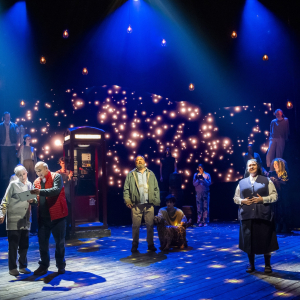
The first half of The Unlikely Pilgrimage of Harold Fry also serves as a kind of homage to the English countryside. The beauty and wonder of this landscape awaken something in Harold, becoming an essential part of his journey of self-discovery.
That connection to nature is distinctly British. Even for those who live in cities, there remains an instinctive affinity with the land and its greenery that binds us together as a people. London itself, with its more than 3,000 parks and public green spaces, remains one of the world’s greenest cities.
The Unlikely Pilgrimage of Harold Fry begins with a character called The Balladeer, played by Noah Mullins, who guides us into the world of the story through the opening number. The figure appears sporadically throughout the first act, a puckish presence crowned with a garland of flowers, as though they had wandered in from Glastonbury. Whether or not this was the creators’ intention, I found the character immensely irritating. Mullins has a serviceable singing voice and is a competent dancer, but the role itself is insufferable.
I much preferred them as David, where they handled their scenes with skill and assurance. The role of David is a difficult one to manoeuvre — not only because of the character’s emotional weight, but also because of the way the part is conceived here: episodic and fleeting in its stage presence. Mullins nevertheless manages to create a coherent whole from these scattered parts.
The musical has a folk-tinged score by the English singer-songwriter Michael David Rosenberg, better known by his stage name, Passenger. Alongside the folksier material, there is a scattering of musical-theatre power ballads, confessional numbers, Golden Age of Hollywood pastiche, and comedy songs. As both composer and lyricist, Passenger appears most comfortable and convincing in the folk idiom. I found myself longing for the show to discover a voice of its own.
The Unlikely Pilgrimage of Harold Fry was adapted into a film in 2023, starring Jim Broadbent and a host of other notable British actors. Since seeing this musical incarnation of the novel, I have wondered why the material needed to sing at all. The most engaging element of the production is the story itself; the songs are superfluous. They rarely advance the plot, take us further into the characters’ inner lives, or reveal anything we do not already know. More often than not, a character ends a song in much the same emotional place in which they began it. Many numbers do not emerge organically from the action or from emotional states that demand expression through music; instead, they arrive somewhat jarringly, as though they do not quite belong in this telling.
Passenger’s lyrics are rudimentary: I found myself predicting in advance how the rhymes would end, and was almost always correct. They reinforce the impression that the fundamental flaw here lies in how little the songs add to the whole, raising once again the question of why this needed to be a musical at all.
Passenger receives a helping hand with the score: the arrangements, orchestrations, and additional music are by Jeremy Holland-Smith, with musical supervision and additional music by Phil Bateman. It is all competently done, but the score never takes flight. Whenever it seemed about to soar, I found myself willing it on, only for it to remain stubbornly grounded.
The Unlikely Pilgrimage of Harold Fry does not need to be a musical; making it one seems unnatural. Its creators have not found the imaginative key that would justify its needs to sing, most likely because there is no compelling reason for it to do so. It would work far better as a play, since every emotional and creative high point comes in a book scene.
Katy Rudd’s production is as slick as it is generic. I felt as though I had seen hundreds of shows with precisely the same directorial DNA: a bare stage, actors moving objects on and off, door frames twirled into place, performers lifted by the arms from either side, puppetry, and street-dance-infused choreography. It is as if the production has no original thought of its own and so happily gobbles up every British theatrical cliché of the past thirty-odd years to fill in the blanks.
Though minimal in nature, Rudd’s production is also prone to odd flashes of extraneous excess, such as when Harold is encouraged by the Garage Girl to ‘believe’ in the song Walk Upon the Water. Midway through the number, she undergoes a wardrobe reveal into a blue sequined dress. What this is intended to convey remains unclear — especially when the dress is as unflattering and poorly constructed as it is here.
This tonal confusion is unfortunate, because what Rudd does have at her disposal are two central leads who deliver subtle, finely drawn performances: Mark Addy and Jenna Russell.
Mark Addy is not a singer and, mercifully, has only a couple of songs in the two-and-a-half-hour production. It hardly matters, because his acting is sublime: complex, detailed, and deeply moving. Addy is a quintessentially English actor in the best possible sense, and there is something deeply recognisably English in his work here. It is a joy to watch. He seems fully to inhabit Harold. I even appreciated the moments when he dances; he appears entirely at home, moving with a surprising grace that reveals another layer of the character.
Addy is such a fine actor that he almost makes some impossible scenes work — as when he finds someone going through the pockets of his coat and leaps to the wrong conclusion, echoing an action from the past. This clunker of a scene would sink most performers, but somehow Addy makes it seem less trite than it is.
Russell is a musical theatre veteran whom I have not seen on stage since her wonderful performance as Dot in Sunday in the Park with George in 2006. What distinguished her then remains true now: her exceptional acting ability. She knows how to reach an audience emotionally without pushing or pandering. She is a true actor, and she uses all her skills here. The beauty of Maureen’s youth still lingers, now layered with the disappointment she harbours towards Harold and life itself.
What she is given to sing is mediocre and, unfortunately, the orchestrations often seem to sit outside her range; the same is true of much of the cast. I cannot recall seeing a musical in which so many performers appeared burdened by songs lying so uncomfortably high in their ranges — lowering much of the score would benefit most of them.
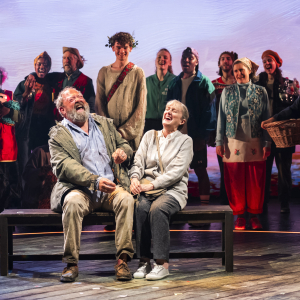
The other performance I greatly admired was Peter Polycarpou as Harold and Maureen’s neighbour and friend, Rex. Though he is underused and the role underwritten, Polycarpou delivers a lovely, assured performance. We come away with a true sense of Rex and, like all good actors, Polycarpou supplies what the text does not, conveying far more than he is given on the page.
Rachel Joyce’s book is a mixed bag. She keeps the action moving and allows the central characters to come into focus, but there are moments when the plot becomes muddled, overburdened by an apparent desire to include as many details from her novel as possible. Storylines are introduced but never fully explored — as when Maureen states that Harold is suffering from undiagnosed dementia because there is a family history of the disease. The idea is raised, but never meaningfully developed or clarified. Perhaps the novel handles it more fully.
It may have been a more inspired choice to bring in a writer with some distance from the source material, a surer instinct for the demands of musical theatre, and enough detachment from the story to recognise what works theatrically and what does not.
My other great disappointment lay in Tom Jackson Greaves’s choreography. Much of it gave me a frustrating sense of déjà vu, coming across as overly formulaic and lacking any genuine sense of place or connection to this particular story.
As with the predictability of the lyrics, I too often anticipated the next move before it arrived. The occasional spark of surprise would have been most welcome. The lifts, in particular, felt like repeated variations on the same theme throughout.
Where Greaves’s work does come alive is in the Act One fantasy tap number between a stranger Harold encounters and the man who will become the stranger's husband. The sequence reveals character, entertains, furthers the subplot, and comes tantalisingly close to being genuinely delightful.
Samuel Wyer’s set is an open expanse, centred on a circular playing area that I initially assumed was a revolve. Its sparseness allows the action to move swiftly, and the various scene changes and shifts in location to take place with minimal fuss. His costumes, meanwhile, are generally serviceable in their support of Rudd’s vision.
The design has transferred well to the Theatre Royal Haymarket, one of the most beautiful houses in the West End. Chichester Festival Theatre, with its thrust-stage configuration, demands a particular design language; as a result, most productions require at least some degree of redesign when moving to a proscenium-arch theatre.
Paul Constable’s lighting design brings both specificity and expanse when required. In conjunction with Ash J Woodward’s video design, it creates moments of real beauty, helping us to see the English countryside as Harold does: with gratitude and a touch of wonder.
Ian Dickinson and Gareth Tucker’s sound design is mostly excellent, and never draws undue attention to itself. There were a couple of moments when I struggled to hear or fully understand some of the performers, but that seemed to stem not from any imprecision in the sound design, but from sloppy diction and a failure to project from some of the cast.
Katy Rudd’s direction embraces expressionism as its main driving force, a peculiar choice for this particular telling of the story. The piece, credited to Rachel Joyce, Peter Darling, and Rudd herself as co-creators, with Joyce as the book writer, remains, for all its shifts back and forth in time, a relatively straightforward tale of a man burdened by regret who ultimately comes to find and forgive himself for his shortcomings, while also discovering his strengths.
Rudd’s production is well executed and rehearsed, and she has cast the two central roles well, despite Addy not being a singer. Yet there are moments when her directorial choices seem laboured — heavy-handed, lacking in trust of the material itself, thus creating an emotional disconnect at precisely the moments when we should be drawn in. Only in the final scene, when she allows the story to breathe, does the production land with the force it should.
It is worth noting that the producers of The Unlikely Pilgrimage of Harold Fry have adopted an excellent performance schedule: Tuesday to Saturday, with matinees on Tuesdays, Thursdays, and Saturdays, giving the cast both Sundays and Mondays off. I wish more shows would embrace such an arrangement, particularly on Broadway, where performance schedules are almost universally identical. It benefits not only performers, crew, and front-of-house staff, but audiences as well, by offering greater flexibility in when they choose to attend.
Despite my reservations about the production, I found myself deeply moved by the final scene between Harold and Maureen on the beach. It allows Addy and Russell to convey what the show’s songs cannot. Unburdened by music, these two stellar actors fill the moment with genuine pathos and humanity, almost making the material sing without singing a note.