
Billy Budd, Glyndebourne Festival Opera, East Sussex, June 2026
July 2026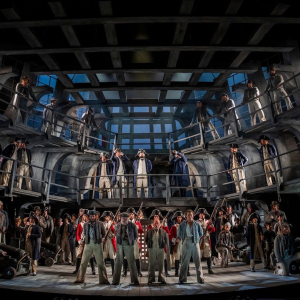
The libretto of Billy Budd is by the novelist E. M. Forster and Britten’s longtime collaborator Eric Crozier. It does exquisite work in creating atmosphere, revealing character and propelling the story through music. This twentieth-century opera stands in marked contrast to the works of Puccini and Verdi, in which melody and vocal line often announce themselves as the central force. Britten, by contrast, seems compelled above all by narrative and psychological pressure. Billy Budd is what might be called a book opera: its power lies in the fusion of narrative, psychology and score.
Restricted View
To view this article, you need to be a member of The Kael Report. Membership supports our ability to publish high-quality reports and insights into the theatre industry and the wider arts. We offer an affordable monthly subscription that helps keep the magazine running.
Related Reading
La Traviata, The Metropolitan Opera House, New York, April 2026
An acquaintance once said to me, “All beautiful things are Italian.” Her comment was made in jest, but also in acknowledgement of the abundance of beauty that has emanated from such a complicated and glorious country: its cuisine; its extraordinary artistic heritage, notably its painting, sculpture, architecture and music; and, more recently, its fashion and textiles. Italy has long beguiled the world as a creative force, and nowhere is that force more powerfully felt than in opera.
The Frick Collection, New York, April 2026
The Frick Collection has been an integral part of my relationship with New York since before I was old enough to drink alcohol legally in the city. Decades after my first visit, I still marvel at its collection and cherish the tranquillity within its walls. Housed in one of the Upper East Side’s last surviving Gilded Age mansions, directly across from Central Park, the Frick functions as an oasis: a place of beauty, stillness and nourishment for the soul.
The Kael Report in Conversation with … Alan Hollinghurst, 21 December 2025, London, NW3
For over four decades, Alan Hollinghurst’s writing has been a commanding presence on the literary landscape. He arrived on the scene in 1988 with The Swimming Pool Library — a dazzling début that struck like a lightning bolt.