
12 Questions with ... Amy Seiwert
August 2026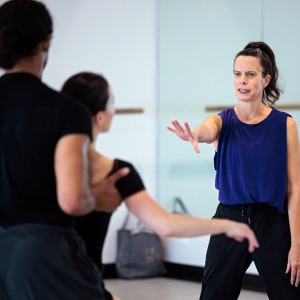
Amy Seiwert photographed by Chris Hardy.
Amy Seiwert is one of California’s most exciting and inventive choreographers. From 2011 to 2024, she led Amy Seiwert’s Imagery, the San Francisco-based contemporary ballet company she founded. From 2008 to 2018, she was choreographer in residence at Smuin Contemporary Ballet, before serving as artistic director of Sacramento Ballet from 2018 to 2020. She returned to Smuin as associate artistic director in 2023, becoming artistic director the following year.
Seiwert had a 19-year performing career, dancing with Smuin, Los Angeles Chamber Ballet and Sacramento Ballet. While dancing with Smuin, she began to hone her choreographic skills under the mentorship of company founder Michael Smuin.
She has developed a reputation as an innovator and risk-taker, approaching ballet with a sensibility rooted in the present and often collaborating with visual artists and musicians.
An Ohio native and longtime Bay Area resident, Seiwert is leading Smuin into its next movement. The company’s 2026/27 season, Smuin in Frame, opens with French Kiss, a programme curated by Seiwert that features her ballet of the same name. The Kael Report put 12 questions to her.
1. Who has inspired your journey in dance?
My family has been incredibly influential here; I come from a long line of folks who were able to make a living in the arts. My mother taught junior high chorus, my paternal grandfather played the organ in church, my maternal grandmother taught piano in her living room, and my aunt had a career as a tap dancer on Broadway. I always found home in being able to express myself physically through music, and that passion was supported at an early age.
2. How do you go about creating a Smuin season?
It always feels like a puzzle; the good news is I love puzzles. I consider multiple variables in hopes of finding the perfect balance. What will challenge the dancers and foster their creative growth? What is our audience craving? How do I honor the legacy of our founder? Is there a diversity of creative voices? Will our community see themselves on stage? Once all those pieces are on the table, how do they fit? My goal, always, is to curate a season any audience would want to see and that any dancer would want to dance.
3. As a new season approaches, what keeps you up at night?
Two things.
The state of funding and the non-profit structure in the US demand constant attention. Because of this, many ballet companies become risk-averse, which can limit innovation in our art form. When this happens, the art form becomes less relevant, which diminishes funding, which leads to people becoming more risk-averse. It’s not a great cycle.
Dancer injuries are the other. We’re a small company and don’t have a “bench.” There aren’t people waiting in the wings if a dancer has an injury. A dancer performing while injured can have a negative long-term effect on their career. Ideally, we catch overuse injuries before they balloon into a major problem. In my ideal world, Smuin artists have access to physical therapy the way a professional sports team does: someone on site, all the time. For a company of our budget size, we don’t have that reality.
4. Can you tell us about the inspiration behind French Kiss?
French Kiss has a different look and feel than many of my ballets, it’s more in the style of a Michael Smuin or Jerome Robbins work. While not a complete narrative, it is character-driven and utilizes props in a way that was a new exploration for me. The music is a mix of songs recorded by Pink Martini, all sung in French. My parents lived in Paris for a few years when I was in my 20s, and I had the good fortune of spending extended time there. The city left an imprint on me, and this piece is a love letter to that time.
5. What is your five-year plan for Smuin?
When I came to Smuin, I inherited two legacies, creation and curation.
Michael Smuin’s is one of creation. He believed the words “world premiere” had significant value. Because of this, Smuin is a creative powerhouse, presenting world premieres by exceptional artists such as Annabelle Lopez Ochoa, Val Caniparoli, Helen Pickett, and Jennifer Archibald. We’re currently working on a premiere by a brilliant emerging artist, My’Kal Stromile. Michael opened doors for so many young creative voices, I’m proud to continue that practice.
Celia Fushille, Michael’s successor, was an incredible curator. She added masterworks to the company’s repertoire: works such as Petite Mort and Return to a Strange Land by Jiri Kylian, The Man in Black by James Kudelka, and Petal by Pickett. By adding renowned works to the company’s offerings, she elevated the company's standing.
The five-year plan builds on this: Balancing legacy with risk-taking, expanding both regional and world premieres, and elevating emerging artistic voices.
6. How does being based in San Francisco affect Smuin’s identity?
The Bay Area has a history of innovation. Not fitting the mold is a point of pride. By embracing curiosity, we get comfortable taking risks. This can be transformative. Native San Franciscan Gordon Moore, the co-founder of Intel, famously stated, “If everything you try works, you aren't trying hard enough.” I’m inspired by these words, and believe they apply to artistic practice the same way they apply to tech innovation.
7. Do you see change occurring in the dance world when it comes to female leadership, and if so, is it happening fast enough?
It is, finally, happening. Is it fast enough? Unsure. Lasting change tends to be slow, so I am hopeful. Back in June of 2016, someone asked why I wasn’t interviewed for the NYTimes article “Where are all the female choreographers?” I responded that perhaps it was because I was interviewed for a very similar August 2007 NYTimes article, “Often on Point but Rarely in Charge.” I’ve literally been involved in the conversation for decades. I do feel like we’ve finally hit a tipping point, and it’s been a long time coming.
8. For someone visiting San Francisco who knows only the surface of the city, what three things would you tell them to experience to get to know it on a deeper level?
Spend time walking! It’s such a phenomenal place, with amazing views and nature. Walk the stairs in North Beach and look for the parrots. Spend time on the Embarcadero and Ferry Building. Walk along the JFK Promenade in Golden Gate Park then jump on a bike (or keep walking) to see the ocean. And while not really San Francisco, if you have time, go across the Golden Gate Bridge to Muir Woods to walk among the redwoods.
Eat a mission burrito. My favorite is a shrimp burrito from Papalote. La Corneta is my second. Locally, there are strong opinions about your options here.
Experience our art. Of course, you should come see Smuin, and the city has a wealth of other amazing performing arts groups and venues. For dance, SF Ballet, LINES, and ODC are all exceptional. For jazz, SF Jazz and the newly reopened Deluxe are great spaces to get up close to the music. There’s fantastic outdoor visual art at the Embarcadero and Golden Gate Park, and the collections at both the deYoung and SFMOMA are fantastic.
9. What work, in any medium, have you experienced recently that has moved you or left you in a state of wonder?
I love this question; I’m constantly looking for the “awe.” I was recently walking in Pacifica, CA, and saw the sooty shearwater migration with some humpbacks breaching; that definitely took my breath away.
In terms of art, a recent performance of Wei Wang in La Sylphide at San Francisco Ballet completely rocked my world. His artistry was stunning. While I love more cutting-edge contemporary work, I’m also a Bourneville geek. His performance was sublime.
10. What is the best part of your job?
When I’m working in the studio with artists and time disappears. There’s something frictionless sometimes; it’s rare. There is a feeling of the ballet unfolding in front of you; you’re revealing it, not creating it. During that process, you’re seeing things before they exist, and they’re simultaneously obvious and surprising. Everyone in the room is on a voyage of discovery together. It’s all highly satisfying.
11. What qualities do you look for in a dancer?
Curiosity. The creative process is about exploring what we don’t know. It’s a leap into the unknown. As Smuin does a lot of new work, that mindset is incredibly valuable.
12. What is the best advice you have ever received?
Write down your values, look at them every day.
Smuin Contemporary Ballet begins its 2026/27 season with French Kiss, curated by Artistic Director Amy Seiwert:
11–13 September: Mountain View Center for the Performing Arts, 500 Castro St., Mountain View
18–19 September: Lesher Center for the Arts, 1601 Civic Dr., Walnut Creek
9–18 October: Cowell Theater at Fort Mason Center for Arts & Culture, 2 Marina Blvd., San Francisco
For tickets and information, visit smuinballet.org.
Related Reading
The Interview: Michael Novak
Paul wanted the dancers onstage to look like a community of people. There is no single body type. The only body type, really, is a dancer who is very powerful: strong thighs and a strong back. Heights vary. Proportions vary. Their backgrounds vary. Some are ballet dancers, some are musical-theatre dancers, some are actors and some are street performers.
On Our Radar: Autumn 2026
The revered jewellery house Van Cleef & Arpels’ most celebrated association with the world of dance was not one of its own design. In 1966, George Balanchine entered its Fifth Avenue salon, where, dazzled by the emeralds, rubies and diamonds on display, he decided to use the brilliance of the stones as inspiration for a three-part ballet. The resulting work, Jewels, will surely endure at least as long as one of the Maison’s exquisite jewels.